 Skip to content
Was That a Sign From a Deceased Loved One? How to Tell Intuition From Wishful Thinking
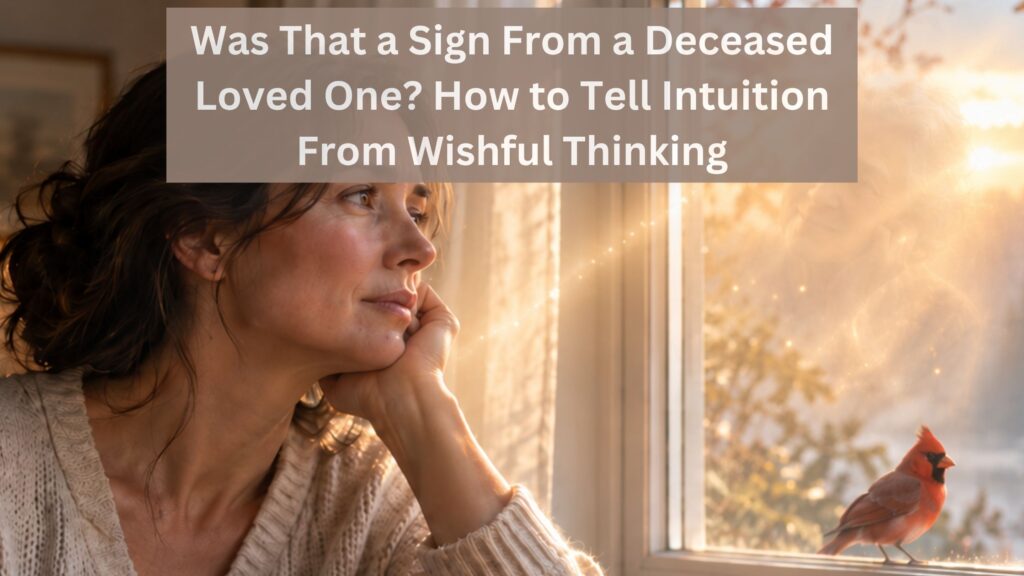
Someone you love dies. Weeks or months later, something happens. Their favourite song comes on at the exact moment you were thinking about them. You catch a scent you always associated with them, and there is no obvious source for it in the room. A bird lands close enough to touch. The kitchen light flickers on the anniversary of their death.
For one second, you think: That’s them.
And then, almost immediately: No. I’m being ridiculous. That was just a coincidence.
In more than twenty years of doing readings, this is one of the questions I am asked very often. How do I know if that was really a sign from someone who died, or if I just wanted it to be? The interesting part is that the answer usually is not found in what happened. It is found in how you experienced it.
🕊️Why We Want Proof So Badly After Someone Dies
Death leaves us holding one of the largest uncertainties a person ever has to live with. You cannot pick up the phone. You cannot ask, “Are you okay? Are you still around me? Can you hear me?” So when something unusual happens, the mind reaches for evidence. And that reaching tends to push people to one of two extremes. One person begins to see everything as a sign. Every song, every number, every dream, every dragonfly. Every ordinary event carries weight, and the day becomes exhausting. The other person dismisses everything. Nothing is allowed to mean anything, because nothing can be proven. My own approach sits somewhere in the middle. Not every flickering lightbulb is Grandma. But not every meaningful experience has to be thrown away simply because it cannot be measured.
🌠A Sign Usually Feels Different From Looking for a Sign
This is the distinction most people have never had named for them. There is a difference between actively hunting for evidence and something unexpectedly getting your attention. Consider two versions of the same event. In the first, you have spent twenty minutes reading articles about cardinals as messengers from the dead. You go outside. You see a cardinal. In the second, you are having a terrible morning. You are thinking intensely about your father. A cardinal lands a few inches from you, in a place you never see cardinals, and stays. Does the second one scientifically prove anything? No. But emotionally and intuitively, the two experiences do not feel the same. And you are allowed to notice that. When you go looking, you will almost always find something. Your attention is already pointed at it. When something arrives without being summoned, and it stops you in your tracks, that is a different kind of experience.
⏳Pay Attention to the Timing, Not Just the Event
Most signs feel significant because of timing and context, not because the thing itself was rare. A song you have heard five hundred times is not remarkable on its own. Hearing that song in the first thirty seconds after you silently asked your friend a question is a different experience. So instead of asking, “Was that a sign?” try asking:
- What was I thinking about right before it happened?
- What was I feeling?
- Had I just asked something?
- What did I sense in the first second, before my analytical mind started explaining it away?
I am not suggesting that your mother rearranged an algorithm. I am suggesting that the timing of an experience is part of the experience, and it is worth noticing rather than editing out.
💭Intuition Is Usually Quieter Than Fear or Wishful Thinking
Wishful thinking tends to sound like need.
I need this to mean they are still here. I need this to prove something.
Fear tends to sound urgent.
What if they are trying to warn me? What if something is wrong?
Intuition is often much plainer than either one.
That was Mom.
And then, a moment later, the mind arrives with its objections. That’s ridiculous. How could it possibly be her? You’re grieving. You’re seeing things. Notice the order. The quiet impression usually comes first. The argument comes second. This is something you can actually practise observing. Not deciding. Not proving. Just noticing what your first impression was before the commentary started.
✔️Don’t Force Every Unusual Thing Into a Spiritual Meaning
I want to be honest here, because I think it matters. Sometimes a lightbulb simply needs replacing. Sometimes a bird is a bird. Sometimes a song came on because an algorithm put it there. Sometimes you dreamed about your partner because you miss them terribly and your mind was processing that. And that is okay. Spirituality does not require abandoning common sense. Discernment is not the opposite of intuition. Discernment is part of developing it. Learning intuition is not about believing everything is a sign. It is about becoming better at noticing which experiences genuinely feel meaningful to you. The people who struggle most are usually not the ones who believe too little. They are the ones who have stopped filtering anything at all, and now cannot tell the difference between a message and their own anxiety.
🌙What About Dreams of Someone Who Died?
Dreams come up in almost every reading involving grief. Ordinary grief dreams and what people describe as visitation dreams often feel dramatically different to the person having them.
A visitation-type dream is frequently described as:
- unusually vivid, more real than a normal dream
- peaceful, or emotionally intense in a way that lingers
- the person appearing healthy and well, not ill or frail
- a direct interaction, conversation, or message rather than a scene you watch
- waking with an unusually strong sense that it actually happened
I am not going to tell you that every dream of this kind is spirit contact. Whether you interpret it spiritually or psychologically, some dreams simply leave a very different impression than ordinary dreaming does, and most people know the difference the moment they wake up.
😟What If You’re Afraid You’re Just Imagining It?
This is the part that carries the most emotion, so I want to take the pressure off. You do not have to make one experience prove something enormous. You do not have to decide, based on a cardinal, whether the afterlife exists. You are allowed to hold it more gently than that.
Try these questions instead:
- Did this experience bring me comfort?
- Did I immediately associate it with this person?
- Did something about it feel unusually meaningful?
- What did I sense before I started analyzing it?
Notice that none of those questions require certainty. You can stay curious. Curiosity is a perfectly reasonable place to live while you grieve, and it is a great deal kinder than demanding proof from yourself.
🤲How to Become More Receptive Without Chasing Signs
If you want to be more open to these experiences, the work is mostly about lowering the noise, not increasing the searching.
- Sit quietly sometimes, without a task.
- Journal unusual experiences as they happen, without deciding what they mean.
- Notice patterns over weeks rather than interpreting single events.
- Pay attention to dreams, especially the ones that feel different on waking.
- Spend some time without constant stimulation.
- Notice your first impression before your explanation.
- Learn the difference between fear, hope, analytical thought, and intuitive response.
And this one matters most: do not spend your entire day looking for evidence. Chasing signs tends to produce anxiety, not clarity. Grief already asks enough of you. Let experiences come to you.
🕉️Final Thoughts
You may never know for certain whether that song, that scent, or that bird was your person. But certainty was never really the question underneath it. The question underneath it is usually, are they okay, and am I still connected to them? What I can tell you is that these experiences are extraordinarily common, that people describe them in remarkably similar ways across every background I have worked with, and that the ones which feel meaningful tend to arrive quietly, at strange moments, when you were not hunting for them. You are allowed to find comfort in something you cannot prove. You are also allowed to say, “That was probably just a coincidence,” and let it be an ordinary Tuesday. Learning which is which is not about believing more. It is about listening more honestly.
✨Want to Understand Your Intuition More Clearly?
One of the hardest parts of intuitive development is not receiving impressions. It is knowing what to trust.
Was that intuition? Fear? Wishful thinking? Coincidence? Your own thoughts?
That is exactly why I created Intuition Foundations. The digital workbook and audio companion help you start recognizing how your intuition communicates, understand what is getting in the way, and practise building real trust in what you sense.
📖 Get instant access — $25 → Intuition Foundations: How to Tell the Difference Between Intuition, Anxiety and Imagination
🎙️ Listen to the podcast: Why Everyone Feels Stuck Right Now: A Psychic’s Perspective on Uncertainty
🔮 Book a psychic reading with me: Book your psychic reading
