 Skip to content
Signs You’re Holding Onto Something You’ve Already Outgrown
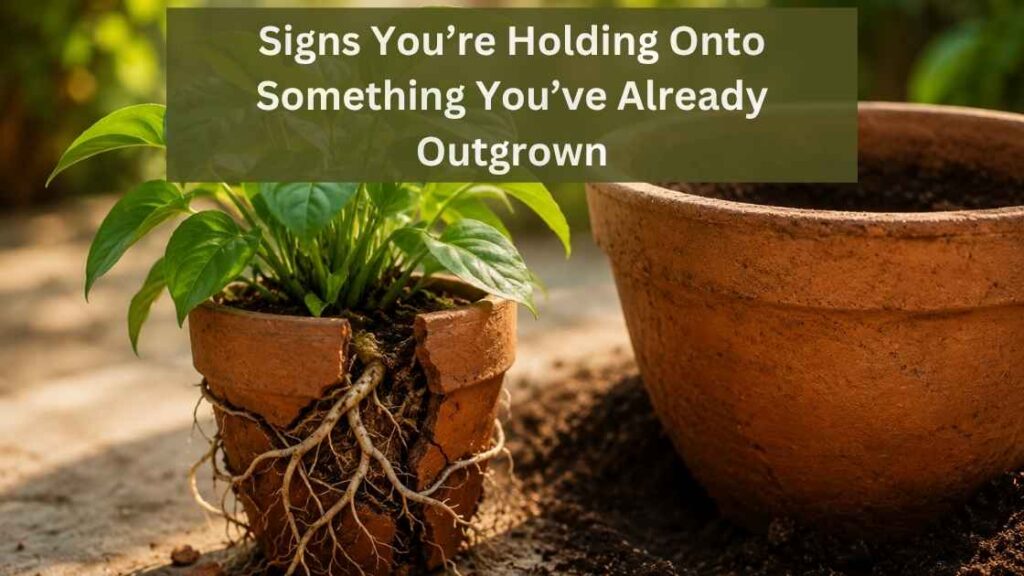
Have you ever kept showing up for a relationship, a job, a routine or a version of yourself that no longer fits — and couldn’t quite explain why? Perhaps you’ve told yourself it’s loyalty, or practicality, or just “not the right time” to change anything. Sometimes that’s true. But sometimes what looks like commitment is actually attachment to something that has already run its course. Growth doesn’t always announce itself with a clean ending. More often, we outgrow a person, a role or a plan quietly, long before we’re willing to admit it — and we keep living inside it anyway, out of habit, fear or hope that it will return to what it once was.
Not every hard situation is something you’ve outgrown. Some relationships and paths are worth the effort it takes to repair or rebuild them. However, if a part of your life has started to feel like a costume rather than a fit, it may be worth asking what you’re actually holding onto, and why.
Here are several signs that you may be holding onto something you’ve already outgrown.
You Keep Trying to Recreate How Something Used to Feel
You may find yourself chasing the early version of a relationship, a friendship, a career or even a place — the version that existed before things shifted. You remember how it felt when it was new, or easy, or exciting, and you keep reaching for that feeling rather than responding to what’s actually in front of you now. This isn’t unusual. The mind is drawn to memory because memory is safe; it’s already resolved, already familiar. But a memory can’t grow with you, and no amount of effort can turn today back into a moment that has already passed. If you notice you’re comparing your current reality to a highlight reel from months or years ago, it may be worth asking whether you’re attached to the situation itself, or to the feeling it used to give you.
You’re Staying Because of How Much Time You’ve Already Invested
“I’ve put five years into this” can quietly become the reason for putting in five more. This is a common and very human pattern — the more we’ve already given to something, the harder it feels to walk away, even when walking away is what our present self would choose. Some call this the sunk-cost trap. It isn’t a character flaw; it’s how most people are wired to think about loss. But time already spent cannot be un-spent, no matter what you decide next. The only real question is whether this path is still worth what it will cost you going forward, not what it has already cost you to arrive here.
The Thought of Letting Go Scares You More Than Staying Excites You
Pay attention to which feeling is actually driving your decision. If you notice that staying isn’t something you’re excited about, but leaving feels unbearable to imagine, that gap is worth sitting with. Fear of the unknown can be a genuinely useful signal — it can protect us from real risk. But fear can also disguise itself as intuition, whispering “stay” simply because staying is familiar, not because staying is right. Ask yourself honestly: are you staying because this still serves you, or because you can’t yet picture what comes after it?
You Keep Waiting for Someone or Something to Change
You may find yourself living slightly ahead of your actual life — imagining the version of this relationship, job or situation that could exist if only one thing were different. That imagined future can become more real to you than the present you’re actually living in. There is nothing wrong with hope, and change is genuinely possible for people and circumstances. But if you’ve been waiting for the same shift for a long time, it may help to separate what you hope will happen from what has actually been happening. The situation in front of you is the one you’re living in today — not the one you’re waiting for.
You’re Repeatedly Asking for Signs About the Same Thing
Some people ask the same question of the universe, a tarot deck, a friend or themselves, over and over, hoping for a different answer than the one they keep receiving. If you notice you’re seeking constant reassurance about the same decision, it can be worth asking what that repetition is actually telling you. Often, we don’t keep searching because we don’t know the answer — we search because we already sense it, and we’re looking for permission to feel differently about it, or for a version of the answer that doesn’t require anything to change.
Something New Is Trying to Enter Your Life, But You Don’t Have Room For It
You may notice new opportunities, people or ideas showing up at the edges of your life — an invitation, an offer, a spark of interest — that you don’t have the time, energy or emotional space to actually receive. This can be one of the clearest signs that something old is still taking up space that could be used differently. It doesn’t mean the new thing is automatically right for you, or that you have to chase it. But it may be worth noticing what, exactly, is currently occupying the space where something new would otherwise fit.
You Know You’re Different From the Person Who Originally Chose This
Look back at who you were when you first said yes to this relationship, job, home or plan. Your priorities, needs and values may have shifted since then, even if the circumstances around you haven’t. This is one of the quieter signs, because nothing dramatic has to happen for it to be true — you simply keep living inside a decision that an earlier version of you made, for reasons that made sense to that version of you at the time. It can help to ask not “was this the right choice back then,” but “is this still the right choice for who I am now.”
How Can You Work Through What You’re Holding Onto?
Recognizing that you’ve outgrown something doesn’t require an immediate decision. Approach it with curiosity rather than pressure. You might begin by journaling honestly about where in your life you feel the most resistance to change, and where you feel the most relief at the thought of it.
Consider asking yourself:
- What am I holding onto — and is it the thing itself, or the memory of it?
- What would I choose if I weren’t afraid of the unknown?
- Whose expectations am I still living inside of?
- What is trying to enter my life that I currently don’t have room for?
- What would it look like to meet this moment as who I am today?
It’s worth remembering that letting go doesn’t always mean ending a relationship, quitting a job or making a dramatic change. Sometimes what needs to be released is smaller and quieter than that — an expectation, an old identity, a resentment, a plan you never revisited, the need for an apology that may never come, or the belief that life has to unfold in one particular way. Letting go is rarely one decision. More often, it’s the slow work of noticing what you’re still carrying, and asking whether it’s still yours to carry.
